


The headlines in the Times of India today are glowing. “Indian Origin Scientist Wins Nobel for Geo Science Prize,” they scream, referring to the recent recognition of Veerabhadran Ramanathan’s life-altering work on climate change.
As a nation, we swell with pride. We claim him as “one of our own.” We did the same for Sunita Williams, Sundar Pichai, and Satya Nadella. But while we are busy celebrating their DNA, we are ignoring a cold, hard economic reality: Pride doesn’t pay the bills; Intellectual Property (IP) does.
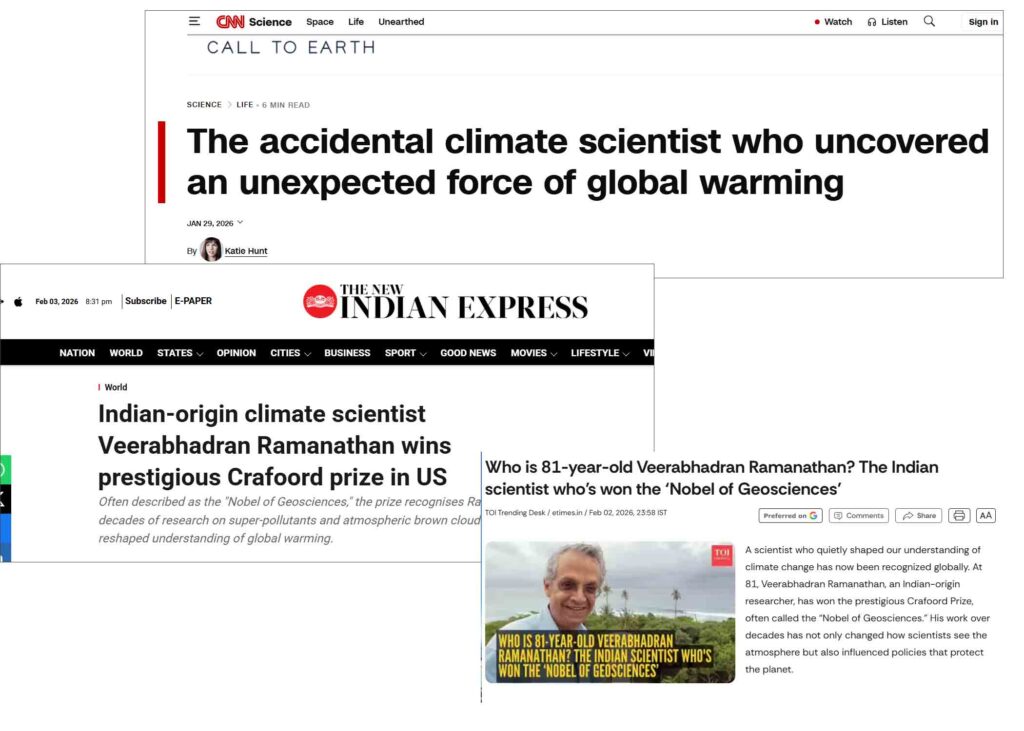
The Vanity Dividend: Who Actually Profits?
When an Indian-origin scientist wins a global prize, the media focuses on their birthplace. But if you “follow the money,” the story changes.
For a scientist like Ramanathan, the breakthrough research happened in California. The lab was funded by US taxpayers. Most importantly, any associated patents are owned by the University of California, not an Indian institution. Under the US Bayh-Dole Act, the university owns the rights, the US government gets the strategic lead, and the scientist gets a royalty cut.
India’s share? A headline and a sense of “feel-good” nostalgia.
The Comparison: Indian Media vs. The World
There is a stark difference in how success is “branded” globally:
| Feature | Indian Media Narrative | US/EU Media Narrative |
| Focus | Ethnicity: “The Indian who did it.” | Institutional: “The Stanford/MIT breakthrough.” |
| Goal | National Pride / Validation. | Attracting R&D Funding & Talent. |
| Outcome | Emotional Satisfaction. | Economic & Strategic Dominance. |
The AI Existential Crisis: From “Backend Hub” to “Sovereign Brain”
You’ve heard the fear: “AI will take over coding. India will lose its cheap labor advantage and be pushed back to ‘Third World’ status.” If we remain a “service-only” nation, that fear is valid. If we only produce “hands” to work on American software, AI will indeed replace us. However, as of February 2026, the data suggests India is pulling off a massive pivot.
Sovereign IP (BharatGPT): Unlike the US-centric GPT models, India’s BharatGPT owns the IP for 22 Indian languages. This is “Sovereign AI”—technology that the West cannot build and must eventually license from us. Just for Note: BharatGPT is primarily developed for B2B & B2G ( Government)
The GPU Mission: India has stopped just “hiring developers.” Through the IndiaAI Mission, the government has deployed a “Common Compute Pool” of over 38,000 GPUs. We are building the engines, not just driving them.
The Stanford Index: In the 2025-26 Global AI Vibrancy Index, India is now ranked 3rd globally—ahead of the UK and Japan. This isn’t because of the diaspora; it’s because of the 5 million+ developers currently building in Bengaluru, Hyderabad, and Pune.
The “Sunder Pichai” Fallacy
Critics argue that CEOs like Pichai and Nadella only invest in India for “competitive advantage.” They are right. They aren’t charities.
However, their “Indian-ness” provides India with Strategic Priority. When Microsoft commits billions to AI infrastructure in India, it’s because a CEO who understands the market’s scale is at the helm. They aren’t giving India “gifts”; they are giving India a seat at the table. It is up to us to stop sitting at that table as “students” and start sitting there as “owners.”
Final Verdict: The End of the “Origin” Headline
We will truly be a global superpower not when an Indian-origin person wins a Nobel in America, but when a foreign-origin scientist moves to Bengaluru to win one.
The “Indian-origin” headline is a crutch for a nation that used to export its best brains. Today, with the rise of Sovereign AI and indigenous IP, it’s time to throw the crutch away. Let’s stop taking credit for the diaspora’s success and start creating the infrastructure that makes them want to stay.
What do you think? Are we over-celebrating the diaspora while losing the IP race? Let us know in the comments.